After a long hiatus, my thoughts on returning to write again.
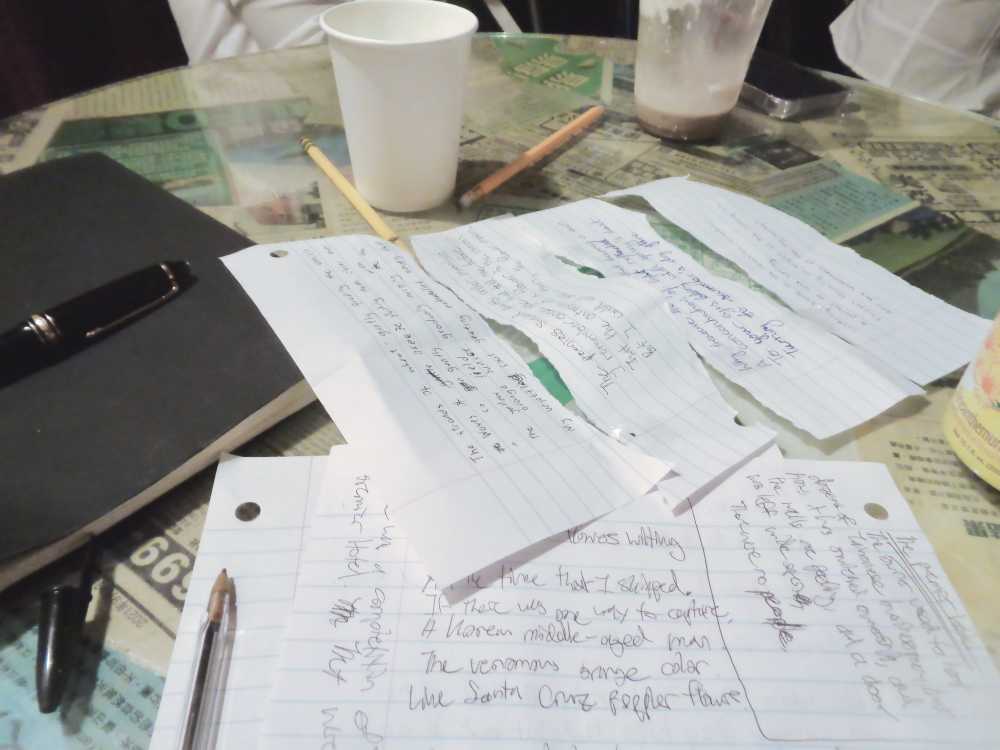
This is my first real attempt to write again. I haven’t been able to bring myself to finish a piece of writing for some years now. Whatever I put down, I always get the sense that it never quite matches what I mean. I would sit in parks, in coffee shops, recording these scattered notes on being in the world, as if at some point they might assemble themselves into something whole. I felt like I was waiting for a life that never began or a God that never existed, some “gathering up” or “bursting forward” of energy that befits creation. But I’ve decided that this is not that. This note, and the notes that follow, will be vague, unceremonious attempts to reach some sort of finality, one that isn’t privileged with knowing exactly what it wants to say or what it means.
Before anything else is said, the primary question: why say anything at all? We use language functionally to live everyday life, but beyond that, what is there to say? Words posit logical, relational assertions understood as information. A sentence is a relation between representations, and can be empirically verified as such. In this way, life has always been simple and straightforward. Ludwig Wittgenstein once wrote, “Whereof one cannot speak, thereof one must pass over in silence.” And maybe that’s right. But still, something insists on being said anyway. Perhaps it’s this inexplicable sense of existential debt that accumulates over the passage of everyday life that demands to be repaid through words.
The problem is that the moment you do say something, the words take on a certain weight, as a kind of declaration. A piece of writing is a declaration because it asserts what something is or how it should be. Once something is written down, it is captured. It stops moving. It can be determined and evaluated. That, to me, is a frightening prospect because my shifting relationship with reality isn’t as solid as a statement. I’ve always preferred to hide behind what things “could” be or how things “might” be. There’s a safety in obscurity and indeterminateness because it avoids grasp. I’m afraid of being pinned down by my own words, and so I linger on them, trying to match them to what I really mean.
But over the years, I’ve come around to believe that we never really say what we mean. That’s because we never know what we mean—we talk in circles around our truth, never head-on. The words we say are designed to orbit the center while pointing at the center, but they will never be the center. Meaning never stays long enough to be held. It leaks out from the bottom, the way vapor escapes any container that tries to enframe it. For that reason, everything we say slightly misconceives reality. Not wrong, just never arriving at the place it longs to be. It’s from an acceptance of that distortion that I attempt to begin writing again.
I think a lot about meaning. I am a brand strategist by occupation. I help brands improve their market value by becoming more meaningful to consumers. In a way, a brand is a sort of commercialized form of meaning—a device that aims to cultivate it, capture it, and transfer it across products. Today, brands in their various forms are one of the main ways we find meaning in our lives. Each brand is a myth. A story that reflects a certain set of identities, values, and overall way to make sense of the world. People align themselves with their chosen myths to feel more defined and coherent, to affirm their own Difference.
We live in the age of Difference. By Difference, I mean the visible aspects of ourselves that separate us, elevate us, and make us socially legible amongst others (e.g. a programmer, a marathon runner, a brand strategist). When something confirms that Difference, it feels good. But it also creates a quiet pressure. A pressure to be defined, differentiated, and consumable within that same shared social field. And so we end up forcing ourselves outwards, again and again, until our Difference becomes a stand-in for who we are and what we mean. It’s a strange condition, isn’t it? You are expected to define yourself to be unique and original, but in a way that is standardized and familiar and altogether unbefitting of the shifting, complicated you.
In the same way as Difference distorts self, words attempt to reveal outwardly a truth that does not remain consistent. The reality that words present hide too much bias, too much assumption, too much distortion. That is why silence must be preserved. Silence is the unperturbed pool in which everything said briefly appears. What is said may outline the silhouette of a self, but what is unsaid becomes the space in which the self is submerged. A life is defined not by what is said but what is not said. And just as silence is the true container of words that declare an unreliable reality, our being is the true container of the unreliable self whose Difference we also declare.
I remember when my words first gave way to silence. It was a few summers ago, after graduating from university, when I had resolved to write a piece, a thesis of sorts, that aimed at a “philosophy” of the world. I wanted to state my worldview outright, with precision, like a mathematical formula. But as my youthful ignorance soon revealed, it proved a lot harder than I thought. What I ended up with was more of a mood piece, a short story that functioned like some sort of aestheticized diary entry, which not only failed to achieve its grand objective of explaining the world, but really didn’t explain anything at all. I remember feeling disappointed at the time, like I was betrayed by something I trusted dearly. Looking back on it now, I think it somehow did capture a way of meaning that was true, in a way.
These days, I doubt if we were ever meant to say the truth outright, as it is. Questions such as, “What is my essence?” or “What is my purpose?” or “What is my fate?” find no answer by design. After all, is the truth something that comes from within, something that is assigned from the outside, or something that is revealed over time? What is the truth of the boy sitting atop a slide at the playground? Is that boy a youthful sunshine prince, or a conglomerate mass of cells, or some future manager at a private holdings fund, or an ancient fractal of a light-filled soul? Each angle reveals something perhaps true, but none of them feel complete.
It’s taken me a long time to come around to something that resembles an old piece of wisdom: neither meaning nor truth can be found buried beneath some surface. Meaning is embedded and relative, it is never absolute. It isn’t something waiting to be captured or resolved. Every time we try to define it fully or pin it down, we lose something fundamental about it. Perhaps what matters most, then, is the activity itself. The depth of that activity, the sincerity of how you relate with that activity, which creates the authenticity of the activity as something that doesn’t need to be fully said in order to be real.
If I might assign some cohesive theme to these writings, it might be the sense that there exist signs that point to something larger and more mysterious than themselves. That these words are meaningful only as attempts at meaning. That there is always something slightly out of reach. But even that feels too posturing, too declarative. Perhaps there’s a better way to say what I really mean. Or perhaps this is all just some vague record of someone trying to understand something internal. Or perhaps that’s all writing has ever been.
Posted on Substack in May 2026.
 tannoyblanc
Leave a comment