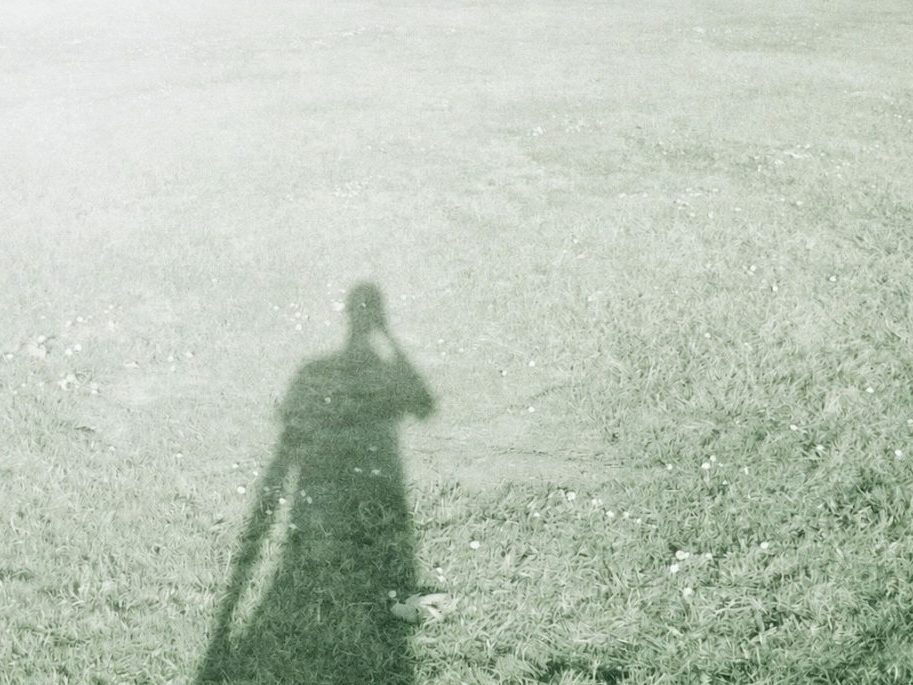
Basho — in Zen and Kyoto School philosophy, the “place” where self and world meet.
There is a place in Berkeley that exists only to me. It’s hidden somewhere along the eastern edge of campus, quiet and ordinary to those passing by. To others, it must have been another route to class, but to me, it became a place that stayed behind. These days, long since I’ve left the Bay, it still returns to me, an image blurred now by time. And on certain midweek mornings, in the heat of midsummer New York, packed shoulder to shoulder with commuters on the Manhattan-bound N train, a feeling comes over me like a gust of wind. I look out the train window, the city flickering past, and for a moment I am back in my luminous university days. Years have gone by since I’ve sat underneath that oak tree, and yet I still find myself returning to it, again and again, as though it were a place I had entered but never truly left.
I was 20 then. It was springtime in the forested hills of Berkeley. The days were always cool and pleasant in the Bay Area. The Northern Californian sun would cast its pale white light over the town, while the air remained heavy from fog of the night before. The university, set against a slope, sprawled ever so slightly at an incline, so that students would need to walk uphill to move from one end to the other. There was a path that traced the edge of campus, starting from the western end and winding steadily upward toward the east. Almost every day around noon, I would set out along this path, slowly making my way up to the top of the hill, until I reached it.
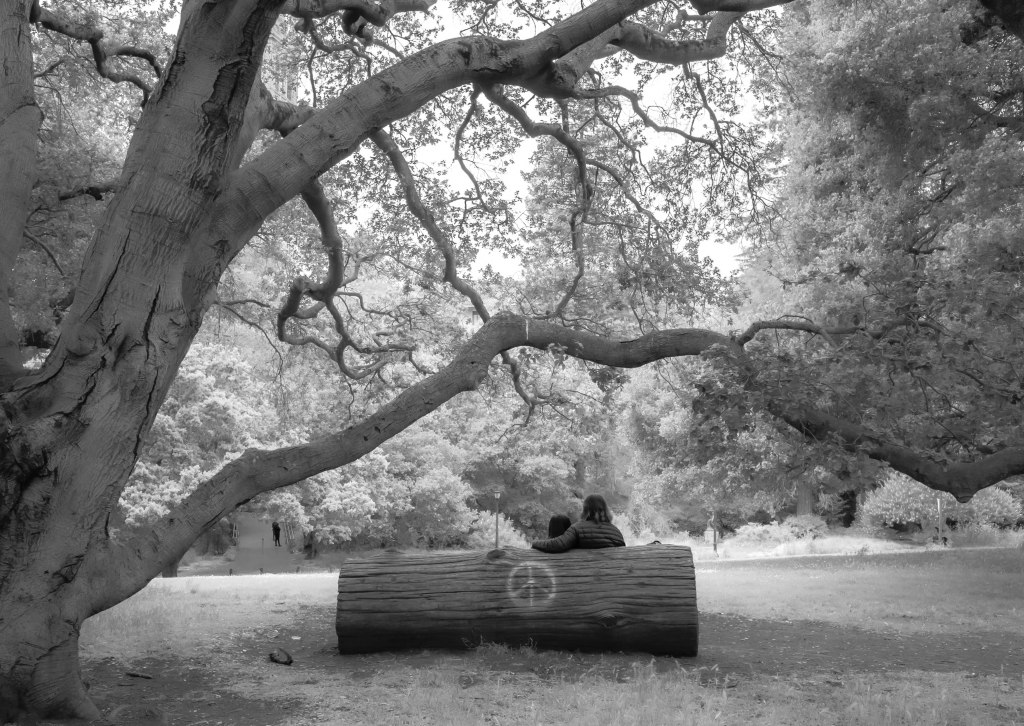
It was a small grove where the music classrooms met the sociology buildings. I would enter a clearing that was landmarked by a large oak tree, whose canopy stretched wide enough to cover its entirety. Beside the tree sat a sturdy log bench, into the back of which someone carved a peace sign, and beyond the tree was a grassy, sloping hill, which students would sometimes tumble down for fun. Further still, a small stream marked off the place’s border, giving way to the larger campus. In my memory’s eye, the dwarvenly-shaped, peach-colored buildings surrounding the grove, set against the green shrubbery and the enormous oak tree, gave the place an indeterminably washed-out atmosphere.
Looking back, the place had found me at a fateful time in my life. That year, I had entered a strange transitory phase: like a changing of the seasons, I was hovering between instances of self. On one hand, I had just reached an important milestone. My college career, which had consisted of what seemed to be an endless stream of career-building activities, had finally culminated in a job offer. But in place of excitement, I felt an indescribable opacity, a bleak open-endedness, like I had reached the limit of a world I couldn’t see the other side of. I suppose that achieving such a goal had marked the conclusion of a story I had been repeating to myself since high school, and for the first time, I found myself with nowhere to be, and nowhere to go.
And so day by day, I would walk up the hill and sit on the log bench under the oak tree, eating my lunch while listening to music, absorbed in the stillness. I remember observing whatever fragments of student life happened to pass before me: a heavyset football player in a tight white tee lumbering towards his next class, a wide-eyed couple drifting about in an innocent, first-love romance, an exhausted-looking TA laying down with his head resting on his backpack, gazing up at the sky. These small collegiate happenings, banal and commonplace as they were, felt just slightly bizarre when viewed from an impartial angle, as if you could suddenly see the little wound-up mechanisms behind every movement.
I let myself be taken by these scenes. Figures continued to pass through. Another student walked by the stream on the way to campus. Scrawny and unkempt, his brisk steps called to attention the dangling shoelaces on his white canvas sneakers, which were slipped on hastily and without care. Impersonally, I conjured up an identity and lifestyle for this person: the simple breakfasts he would throw together in the morning, the sporadic and excited cadence of his speech when drinking with his friends, the undecorated dorm he would return to at the end of the night. Passing before me, he was perhaps concerned not about his presentation, but the exam he had been studying all night for. The more details I added, however, the less real it seemed.
A divide deeper than distance alone emerged between myself and what I saw. It was similar to the way a play might appear to its audience as both constructed and genuinely real at the same time. From my seat, I could somehow perceive what was going on backstage. The images of student life projected before me began to feel like scripts being read aloud and acted out. Personalities became characters, their hopes and fears written on their faces like tropes. And as life acted itself out before me, it seemed to lose its immersive quality, as though the fourth wall had fallen away.
Whatever this feeling was, there was an ambient bliss to it. Under the oak tree, one entered a way of seeing that felt broad and lucid, as if its expanse contained all other perspectives. Matters that were previously life and death seemed to lose their imminence, goals that I had oriented my life around became arbitrary, or absurd, like a word repeated over and over to the point of incoherence. And most strikingly, the vertigo of constantly pushing forward into the future had vanished. The stillness was intoxicating. There was something profound about watching things take shape and dissolve before me. It was like water freezing into ice and melting back into itself, an open poetry to a larger question I couldn’t name.
I remember on one particular occasion, I found myself gazing up at a bluebird perched above me on a branch. That day, the grove was silent and uninhabited. Only an empty exhale of air remained. The bluebird stood atop its branch, upright and stoic. Every once in a while, it would make some slight twitching movements, reflexive and immediate, distinguishing it against the eucalyptus green of the background. A light gust of wind passed. A branch swayed. A squirrel scurried down the trunk of the tree and disappeared back into the bark. The bird chirped once and flew away. Departure. And it was stillness again. Stillness, taking the form of an oak tree. Stillness settling into the classrooms beside it. Stillness gathered into the outline of a grove, the expanse of the larger campus surrounding it, the boundaries of a city called Berkeley, and the states and countries beyond. I saw it all as one universal posture, a larger whole-being behind each distinct entity. Not instances of life, but life itself.
At the time, I didn’t have the language to put words to how it felt. Yet still, I could feel the place speaking to me in a shapeless pattern of impressions. The rustle of leaves, the refraction of sunlight on windows, the murmur of conversation from passing silhouettes. It was a dance of leaf-words and shadow-poetry that lived between the world and my perception of it. The longer I sat beneath the oak tree, the more that boundary seemed to soften. And for brief moments, it seemed like there was no longer a future to move towards, a past to recount, or a self to defend. There was only the afternoon light, the sound of the stream, and the feeling that everything had already happened.
What stayed with me through all these years was that feeling of distance. From that distance, the seriousness of everyday tasks, the larger goals that sit behind them, and the unifying idea of individual happiness, were merely the concerns of a bounded life. Whichever path you chose, whatever game you played, whatever prizes you sought to accumulate; it was only as real as a line drawn in the sand, only meaningful for the sake that you chose it, not for any grander purpose.
I remember trying to explain to J. what it had felt like, that existential distance. “The world is ego,” I had said, but maybe what I should’ve said was that the world was boundary. Not the boundary between being and nothing, but the boundary between one thing and another. And this was a place where my sense of boundary had weakened, my own lines of distinction distorting, a distance from immediacy. The students, the classrooms, the trees, all malleable, all temporary. A garden of words. A place made of words, words just like this, words that fall away like leaves on an oak tree, existing briefly for the sake of its own expression, with only ambient, paradoxical stillness underneath.
The Japanese philosopher Kitaro Nishida argued that basho, or “place,” is where experience arises between self and world. But looking back, I wonder if the self is not something that exists within the place, but that the self is the place. The world that appeared to me then still exists in its ambiguity, preserved somehow on another plane, even when the stream has long since dried up, the students have all graduated, and I myself am no longer there. And through the temporality of each stage of my life and the expendability of words I use to describe them, the self from under the oak tree remains, in that distant afternoon light, sitting perfectly still.
This is a short prose piece exploring the feeling of existential distance. It is inspired by my study of Kyoto School philosopher Nishida Kitaro and his idea of basho, or “place.” During the period of time in which I wrote this piece, I was sleeping more than I usually did, and dreaming more vividly as well. My meditation practice had been put on pause, though for no particular reason. Perhaps for that reason, my mind was welling up with past images. In any case, I write this piece not to assert, but to revisit. Thank you for reading (this piece can also found here on Substack).
 tannoyblanc
Leave a comment